
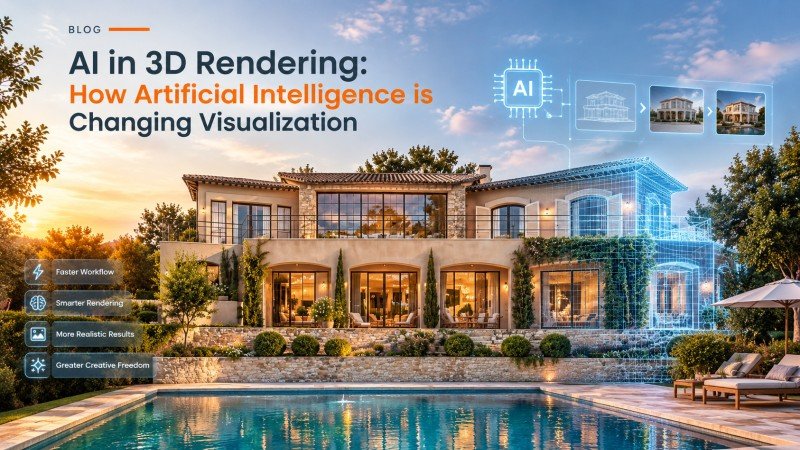
Artificial Intelligence is transforming the 3D rendering industry, not just because of the speed of the hardware, or the quality of the software, but both of these. The 3D rendering industry is in one of its biggest changes in decades, and it’s not due to the speed of the hardware, or the quality of the software, but artificial intelligence. The 3D rendering technology has become a game-changer in the marketing field, especially when it comes to architectural visuals that can be created in no time. Marketing teams can use AI in 3D rendering tools to produce visuals that are far more efficient and dramatically faster, and open up new opportunities for creativity particularly in the architectural field. This article discusses the impact of AI on the rendering scene and its implications for the future of visualisation.
The Traditional Rendering Process vs AI-Powered Rendering
The traditional approach to 3D rendering involves creating detailed 3D models, adding materials and textures, adjusting lights and other settings, and performing time-consuming 3D render calculations, all of which can take hours or days for complex scenes. This process requires a lot of technical know-how and computation.
AI rendering alters this dynamic. AI tools can now make use of large volumes of images and 3D scenes to generate realistic images in just a matter of minutes or even seconds when what used to take hours was once impossible.
How Generative AI Is Transforming Rendering Workflows
Generative AI in rendering involves AI systems that can generate new visual content from textual instructions, sketches, or even reference images, bypassing the need for artists to create everything from scratch. The technology is being incorporated in various meaningful ways to the rendering workflow:
AI-Assisted Concept Generation
Now designers can create several concepts from a simple description of a text or rough sketch, drastically accelerating the initial concept generation stage of a project. AI can generate visual variations of the design for easy review and iteration, rather than having to model a few by hand.
AI Denoising and Render Acceleration
In the realm of traditional rendering pipelines, denoising is one of the most applicable use cases of AI for cleaning up “noisy” render output from faster but less sampled passes in render pipelines. This enables an artist to get a high quality final image much faster than by traditional rendering.
Automated Material and Texture Generation
For example, AI can now produce a variety of material textures, such as wood grain or fabric weave, from user descriptions or reference images, eliminating the need for manual work in achieving believable texture details.

AI in Architectural Rendering
Architects and developers are especially interested in AI architectural rendering because of its ability to save time and help them visualize concepts in the early stages of the design. Using AI can now create photorealistic exterior and interior visualizations from simple 3D massing models, or even simple sketches, allowing architects to convey ideas to clients before the time it would take for a traditional architectural rendering.
This feature can be particularly useful when considering conceptual design since it allows many different design directions to be explored and presented before further development begins. Architects can test out multiple options generated by AI within hours rather than days, instead of waiting for each polished render.
AI in Product Rendering
Alongside 3D product rendering services, AI Product Rendering is also revolutionizing the way brands visualize products for marketing and e-commerce.AI product rendering is also giving a revolution to the way brands visualize products for marketing and e-commerce. Now, AI tools can create several background environments, lighting setups, and even material variations from a single basic 3D model, vastly cutting down the time and effort needed to prepare extensive product visual libraries.
In some instances, AI platforms can even create realistic product renders from 2D reference images or technical drawings, bypassing the necessity for lengthened manual 3D modeling in more straightforward products, particularly for those in simpler classifications.
AI in Interior Design Visualization
AI interior design rendering tools allow homeowners, designers, and retailers to quickly visualize how furniture, and layouts will look within a space. Consumer-based AI applications, in some cases, even let the user upload their image of a room and create AI-sculpted variations of the room with various design styles or arrangements of furniture.
The accessibility of this has made design exploration more accessible for more people than before, from professional designers to mainstream consumer applications of visualization technology.
Benefits of AI-Powered Rendering
Significantly Faster Turnaround Times
The quickest is likely to be speed. Previously, adjustment of lighting, creation of variations, rendering noise removal would take hours to perform manually but can be handled in mere minutes with AI assistance.
Lower Barrier to Entry
High quality visualization is becoming more accessible and available for smaller studios as easier to use tools are developed with AI, and companies that once could not afford to have a large in-house rendering team or outsource rendering for every project.
Rapid Iteration and Exploration
AI can help explore more design possibilities, making it possible to explore more creative ideas in the same project timeline that would only have allowed a few ideas in the past.
Limitations and Challenges of AI Rendering
While AI rendering technology has its benefits, there are some distinct drawbacks to consider:
- Accuracy and consistency issues: The images produced by AI may also contain inaccuracies or unrealistic elements, such as in complex geometry or material specifications.
- Limited control over precise specifications: In complex professional settings, the demands for accuracy are demanding, and some material may need to be matched exactly, or even require brand-specific characteristics that AI cannot capture perfectly.
- Quality variability: The results may differ from one AI tool to another, and even with the same tool, depending on the type of request and the data used for training.
- Professional oversight still required: In situations where clients are involved and the outcomes are critical, human involvement is also necessary for quality control and exact customization.
The Future of AI in 3D Rendering
With the continuous advancement of AI models, the synergy between traditional rendering pipelines and AI-based tools is anticipated to become more seamless and streamlined. AI is not designed to replace skilled 3D artists, but rather to serve as a valuable tool that can assist them in completing repetitive tasks and quickly generating multiple iterations.AI is not intended to replace the role of a skilled 3D artist, but rather to be a helpful assistant that can generate multiple iterations of an idea quickly and automate repetitive tasks, while also allowing the artist to oversee the final creative direction and quality control.
The fusion of AI’s rapidity and human precision is poised to shape the future of professional visualization, whether in architecture or product design and beyond.
Also Read: Cozy Interior Design Ideas for Cold Weather Homes
FAQs
1. How is AI changing traditional 3D rendering workflows?
AI is accelerating the rendering process, cutting hours into minutes.AI can complete long, time-consuming jobs in minutes, like denoising, generating materials on the fly, and visualizing concepts quickly and with quality.
2. Can AI architectural rendering fully replace traditional rendering methods?
Not entirely. While AI architectural rendering is great for quickly visualizing concepts, professional work will still need to be done under the guidance of a human for precision, accuracy, and customization for the client.
3. How does AI product rendering benefit e-commerce brands?
With AI product rendering, you can effortlessly create numerous background scenes, lighting setups, and material options from a single 3D model, saving substantial time on manual work for extensive product catalogs.
4. Is AI interior design rendering accurate enough for professional use?
While AI interior design rendering tools are helpful for concept exploration and consumer-facing applications, professional projects may still need to be rendered to achieve the most accurate results, which can be achieved by human guidance.
5. What role does generative AI in rendering play in the design process?
Generative AI for rendering can speed up the initial concept phase, enabling designers to experiment with various visual ideas based on text-instructions or sketches before dedicating time to in-depth manual design.
Final Thoughts
In the world of visual content, AI 3D rendering is revolutionizing the way that visuals are generated, with promises of unparalleled speed and accessibility, spanning from architecture and product design to interior visualization. AI architectural rendering tools and AI product rendering tools are still developing, but the best combination nowadays is using generative AI tools in conjunction with the human expertise that is needed for top-quality products.
