
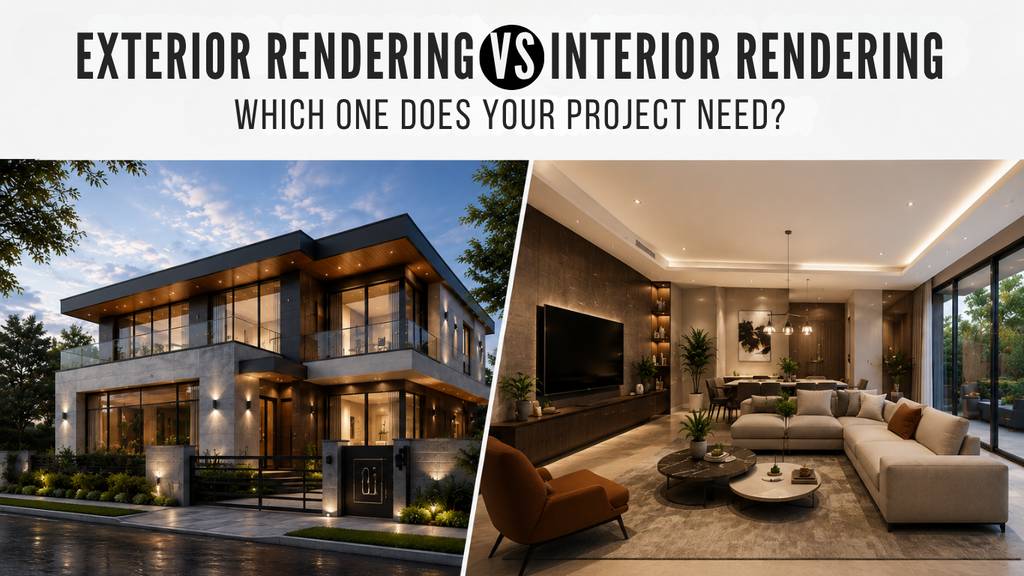
One of the most frequent problems that architects, designers and real estate professionals will encounter when making a presentation of a design project is whether to invest in exterior rendering or interior rendering or both. Knowing the difference between the two, and when to use each one, will save you time, money, and help you to communicate your vision to your clients and stakeholder more effectively.
In this blog, we’ll compare exterior rendering vs interior rendering, the different benefits of each, and how to determine which one (or neither one or two) is the best option for your next project.
What Is Exterior Rendering?
3D Exterior rendering is about visualizing the exterior of a building – the façade, landscaping, environment, materials and architectural shape of a building. Usually applied to illustrate the appearance of a structure from the street, from overhead, or in its neighborhood.
Exteriors renders can be particularly beneficial for:
- Presenting the overall design and massing of buildings
- Emphasizing materials, textures and façade details
- To show the relationship of a building to its environment
- Various marketing materials used by developers and real estate listings
What Is Interior Rendering?
Interior rendering, on the other hand, entails creating the inside of a space come to life. It provides clients with an accurate idea of how a space will feel to live or work in by depicting room layouts, furniture placement, lighting, materials and finishes.
Here are some of the most common applications of interior rendering:
- Visualizing spatial planning, layout and flow of rooms.
- Demonstrate interior finishes, lighting and furnishings.
- Creating sense of place for clients by emotionally engaging them with space
- Optimizing design aspects prior to construction
Key Differences Between Exterior and Interior Rendering
| Aspect | Exterior Rendering | Interior Rendering |
| Focus | Building façade, landscaping, surroundings | Room layouts, furniture, finishes |
| Best For | First impressions, marketing, street appeal | Spatial experience, emotional connection |
| Common Use Cases | Real estate listings, urban planning, commercial pitches | Residential remodels, hospitality, retail interiors |
| Lighting Focus | Natural daylight, sky, landscaping shadows | Ambient, artificial, and mixed lighting setups |
They are not the same but they are not mutually exclusive either most successful projects utilize both to convey a full visual story.
When Do You Need Exterior Rendering?
When it comes to creating a successful project, first impressions, curb appeal, and building integration are important factors to consider, and exterior rendering should be a priority. In particular for:
- Real Estate renderings for property listings and marketing brochures
- Urban development or masterplan presentations
- Commercial buildings where foot traffic is stimulated by street visibility.
- Projects that need city and/or zoning board approvals where exterior form and context is most critical.
When Do You Need Interior Rendering?
When you want to give your client a vision of how they will use and experience a space, interior visualization is a must. Especially for:
- Clients envisioning their future home in residential interior spaces
- Hospitality-based industries that convey the ambiance sold the experience
- Interiors for retail and commercial spaces, where space has to affect behavior of customer
- Any project where furniture, lighting and finishes are a key element in the design process
Residential vs Commercial Rendering Needs
Sometimes the right rendering technique will be dependent on the type of project that you are working on.
Residential Rendering
Balance is key when it comes to a home’s exterior and interior aesthetics, and this is especially true for residential rendering. Curb appeal is important for buyers and homeowners to see and imagine themselves living in the home, which is why both inside and outside renders are important in most residential marketing packages.
Commercial Rendering
In commercial projects the top priority may change according to type of business. Commercial rendering can be more likely applied to the exterior of an office building or retail space to catch the attention of customers or tenants, or applied to the inside of a space to show how it will function, the brand and customer experience.
Why Not Choose Both?
Sometimes the best course of action isn’t to take one or the other, it’s about taking both together. A comprehensive rendering package, with exterior and interior images, provides clients, investors and stakeholders with a 360-degree view of a project. This comprehensive approach is particularly effective in:
- Real-estate marketing campaigns
- Both investors and stakeholders presentations
- Design-build proposals where full scope needs to be communicated
- Real estate estates with top-tier built-out homes and villas
Also Read: How 3D Rendering Helps Win More Architectural Projects
Frequently Asked Questions
1. What is the main difference between exterior and interior rendering?
Exterior rendering refers to the renderings of the exterior of a building, which include the exterior façade, landscaping and surrounding areas, and Interior rendering refers to the renderings of the interior of a building, which include the interior layout and furnishings, interior lighting and finishes.
2. Do I need both exterior and interior rendering for my project?
It will depend on your objective, but many projects, specifically residential and real estate marketing, will profit from the utilization of both, as they supply a total look at the property from the exterior inwards.
3. Which is more important for real estate marketing: interior or exterior rendering?
Exterior renders have the job of attracting the buyer, and interior renders give the buyer a feeling of connection to the space, and a sense of what it might be like to live in — typically, both are used in real estate rendering.
4. Is interior rendering only useful for residential projects?
In the commercial sector, no interior rendering does not also have its application particularly in the hospitality, retail, and office sectors where client experience is influenced by ambiance, layout, and branding.
5. How does lighting differ between interior and exterior renders?
Exterior renders are often designed to capture the natural light, sky and shadow play from the surrounding area, whereas interior renders might incorporate light from the interior as well as the exterior of the building to create a realistic inside environment.
6. Which type of rendering is better for design approvals?
Interior rendering is more useful for design to the client and exterior rendering is typically better for zoning, city or planning approval applications because it will demonstrate how the design fits into the surrounding context.
7. Can exterior and interior rendering be done at the same design stage?
Yes. Many architects employ both at the design development stage to guarantee that the form of the building and the spaces inside are harmonious and consistent with the overall building concept.
Final Thoughts
When deciding between exterior rendering vs interior rendering, it is all about your project’s objectives. Exterior rendering is vital when you need to make a powerful initial impression, attract buyers and get design approvals. Interior rendering is most suitable if you want to help the clients to feel connected to a space and make tweaks to the interior.
For virtually any project, residential or commercial, doing both will create the most complete, convincing visual narrative, making it easier to communicate your vision and gain client confidence throughout the process. Not sure if you need exterior or interior or both? Download price list today and connect us to determine which approach to rendering will work best for you.
